
ADHD “Micro-Sleep” Explained: What the New Local Sleep Research Really Means
Learn what the new ADHD local sleep research actually found, how solid the evidence is, and what it means for attention lapses, mind wandering, and sleep-aware treatment.
⚡ TL;DR
- The new research does not show whole-brain sleep during the day. It shows brief, local, sleep-like slow waves in small cortical regions while a person remains awake.
- Adults with ADHD had more of these events than controls during a sustained-attention task, and the extra slow waves statistically tracked more errors, slower responses, greater variability, more mind wandering, more mind blanking, and more sleepiness.
- This supports a brain-state regulation model of ADHD: some symptoms may reflect unstable arousal and network engagement, not just “poor willpower” or weak executive skills.
- The finding is important but early. The main ADHD study used 63 adults total, so the mechanism is promising—not final.
- The practical takeaway is not “ADHD is just bad sleep.” It is that sleep, circadian rhythm, daytime arousal, and task design deserve a much bigger place in how we think about ADHD care and self-management.
In this article
What “ADHD micro-sleep” actually means
If you want the accurate term, use local sleep or sleep-like slow waves during wakefulness, not literal “micro-sleep.” In this line of research, the person stays behaviorally awake, but small parts of the cortex briefly show slow-wave activity more typical of non-REM sleep. Those local slow waves can momentarily disrupt the specific networks needed for attention, inhibition, sensory processing, or task control. [Nature Communications] [Frontiers]
That distinction matters for SEO, for science communication, and for patients. Saying “people with ADHD fall asleep while awake” is catchy but imprecise. The current evidence supports something subtler: patches of cortex can transiently slip into sleep-like dynamics, and those events seem to become more frequent or more behaviorally disruptive in adult ADHD during sustained-attention demands. [PubMed]
What it is
Brief, local bursts of slow-wave activity in the awake brain that may take small networks partly offline for fractions of a second.
What it is not
Proof that the whole person is repeatedly entering full sleep, or that ADHD can be reduced to “just being tired.”
| Claim | What the evidence says | Confidence right now |
|---|---|---|
| Adults with ADHD show more sleep-like slow waves during wakefulness | A 2026 EEG study found higher slow-wave density in ADHD adults than controls during a sustained-attention task. | Moderate to strong in one well-designed lab study, but replication is still needed. |
| These events track attention lapses | More slow waves were associated with more errors, slower RTs, greater RT variability, lower on-task reports, and more sleepiness. | Strong within the study and consistent with earlier non-ADHD work. |
| Local sleep may help explain mind wandering and mind blanking | Prior work linked frontal vs posterior slow waves to different phenomenology and error types. | Moderate; mechanistically coherent, but still not the whole ADHD story. |
| This means ADHD is caused by poor sleep | No. Sleep problems likely interact with ADHD, but the disorder remains broader than sleep alone. | Low if stated as a complete explanation. |
[PubMed] [Nature Communications]
What the 2026 JNeurosci study actually found
The main paper driving the current ADHD micro-sleep headlines is Sleep-Like Slow Waves during Wakefulness Mediate Attention and Vigilance Difficulties in Adult Attention-Deficit/Hyperactivity Disorder, published in Journal of Neuroscience in 2026. Researchers tested 32 adults with ADHD and 31 neurotypical controls while they performed a sustained-attention task with embedded thought probes and high-density EEG recording. [PubMed]
The ADHD group showed more commission errors, more mind wandering, more mind blanking, more frontotemporal theta activity, and higher sleep-like slow-wave density, especially over parietotemporal regions. Across participants, greater slow-wave density predicted more omission errors, slower reaction times, higher reaction-time variability, greater sleepiness, and fewer “on-task” reports. In mediation analyses, slow-wave density statistically explained part of the ADHD-related performance gap. [PubMed]
Methods in plain language
Participants did a vigilance-heavy Go/NoGo-style task that requires you to stay alert through repetition, respond quickly to common targets, and occasionally inhibit a response to rare non-targets. That kind of task is ideal for exposing the “I was here, then suddenly I wasn’t” pattern many adults with ADHD describe in work, driving, lectures, or admin tasks. [PubMed] [News-Medical]
What the study strongly supports
What the study does not prove
It does not prove local sleep causes all ADHD, or that every ADHD presentation is fundamentally a sleep disorder. It also does not show how these events behave across real-world settings, emotional stress, hyperfocus, different ADHD subtypes, or long-term treatment. The sample was respectable for EEG work, but still modest for making broad population-level claims. [PubMed]
Why scientists call it local sleep
The ADHD paper sits on top of earlier work showing that even healthy, well-rested people can have sleep-like slow waves while awake, especially during repetitive or undemanding tasks. In a 2021 Nature Communications study, researchers found that these local slow waves predicted attentional lapses in healthy adults and were linked to both subjective states and objective errors. [Nature Communications]
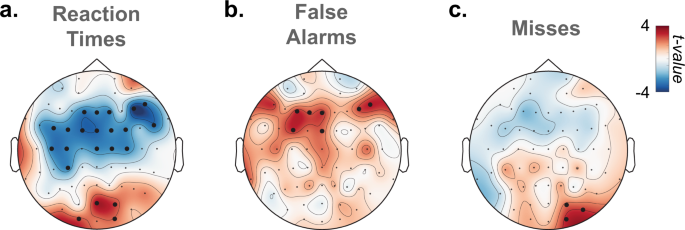
One of the most important findings from that 2021 paper is that location matters. Slow waves over posterior regions were linked to sluggish behavior, slower responses, and missed targets, while slow waves over frontal regions were linked to more impulsive responding and false alarms. That makes local sleep unusually powerful as a model, because it can explain why attention failure can look either “foggy and slow” or “fast and careless” depending on which networks are hit. [Nature Communications]
The theoretical groundwork was laid even earlier in a 2019 Frontiers in Neuroscience review, which proposed that local sleep could be a unifying mechanism connecting attentional lapses, mind wandering, mind blanking, and ADHD. In that framework, ADHD becomes partly a disorder of unstable vigilance and mixed sleep/wake states, rather than only a top-down executive control problem. [Frontiers]
How the default mode network fits in
ADHD researchers have long argued that part of the condition involves unstable separation between the default mode network (DMN) and task-positive networks that support externally directed attention. In healthy cognition, those systems are more cleanly segregated. In ADHD, evidence suggests they are less separated, which may let internal mentation intrude into task performance. [PMC]
Local sleep gives that network story a plausible electrophysiological engine. If sleep-like slow waves hit attention or control networks, externally focused processing may weaken and the DMN can rebound, which could feel like drifting into thought. If slow waves instead disrupt regions involved in internal integration or conscious report, the result may feel less like mind wandering and more like a blank, disconnected pause. [Nature Communications] [Frontiers]
Mind wandering
Often described as spontaneous task-unrelated thought; in this model, it may reflect local disruptions that loosen top-down task control.
Mind blanking
Often described as “nothing in mind” or reduced reportable content; in this model, it may reflect deeper or differently located local sleep intrusions.
This is one reason the local sleep model resonates so strongly with lived ADHD experience: it explains why the same person can oscillate between restless impulsivity, task drift, and brain-off blankness—sometimes within the same hour. [Nature Communications] [PMC]
Is ADHD local sleep just chronic sleep deprivation in disguise?
That skeptical reading is understandable, because local sleep was first studied in the context of sleep deprivation. Extended wakefulness increases slow-wave pressure, and performance gets worse. But later work showed that local sleep also happens in well-rested healthy adults during boring, repetitive tasks. So sleep deprivation is not required; it is better understood as a factor that can increase the probability of local sleep intrusions. [Nature Communications]
Where ADHD becomes especially relevant is that sleep problems are common in the condition. A 2024 study of 3,691 adults with ADHD found that about 60% screened positive for any sleep disorder, with high rates of delayed sleep phase symptoms, insomnia, and restless legs / periodic limb movement symptoms. That does not prove sleep causes ADHD, but it does strengthen the case for sleep and circadian dysregulation as major amplifiers of daytime cognitive instability. [PubMed]
Large registry data also point the same way: people with ADHD have substantially elevated rates of sleep-disorder diagnoses and sleep-medication use across the lifespan, though those estimates likely undercount the full burden of sleep problems because many cases are treated outside specialist datasets. [PMC]
What this means in real life for ADHD attention, brain fog, and “blank” moments
The local sleep model finally gives a scientific frame to a very common ADHD complaint: “I wasn’t distracted by anything. I just disappeared for a second.” That could show up as rereading the same paragraph five times, missing a turn while driving a familiar route, clicking the wrong thing in a spreadsheet, or opening a tab and instantly forgetting why. The new data suggest those moments may sometimes be tied to transient state failures in the brain, not a moral failure, not laziness, and not simple lack of effort. [PubMed] [Frontiers]
It also explains why monotony is disproportionately punishing for many ADHD adults. A repetitive task with low novelty and weak reward cues demands stable external attention without providing much motivational support. That is exactly the kind of context where local sleep-like intrusions seem most likely to surface. [Nature Communications] [PubMed]
At the same time, this framework does not erase the rest of ADHD. Reward processing, emotional regulation, time blindness, task aversion, and hyperfocus still matter. The best reading is additive: local sleep may be one important mechanism inside a broader, more heterogeneous condition. [Frontiers] [PMC]
Practical implications: what the research suggests right now
1) Treat sleep as core ADHD care, not a side quest
If sleep problems are common in ADHD and sleep-like slow waves during wakefulness appear to mediate attention failures, then sleep screening should move closer to the center of assessment and treatment. That includes delayed sleep phase, insomnia, restless legs symptoms, sleep apnea risk, and medication timing. [PubMed] [PMC]
2) Design work around vigilance limits
The research reinforces something many ADHD adults learn the hard way: long, flat, repetitive stretches are not neutral. They are a risk condition. Breaking cognitively dull work into shorter sprints, rotating task type, using visible timers, adding movement or light, and switching high-stakes attention work into higher-arousal windows are all consistent with a local-sleep-aware workflow, even if not yet tested directly in the exact 2026 paradigm. [Nature Communications] [PubMed]
3) Reframe symptoms with less shame and more state awareness
One of the most clinically useful consequences of this research is psychological. If some attention lapses are state failures tied to arousal and local network instability, the intervention target shifts away from self-judgment and toward monitoring conditions: sleep debt, time-on-task, boredom, circadian troughs, unbroken screen time, and task monotony. [Frontiers]
4) Future treatment ideas are plausible—but still early
Press coverage around the 2026 study highlighted a possible future direction: using sleep-based interventions, including auditory stimulation during sleep, to influence next-day slow-wave dynamics. That is an intriguing research path, but it is not yet a validated ADHD treatment. For now, the strongest practical move is still conventional: optimize sleep, screen for sleep disorders, and align ADHD treatment with arousal and circadian reality. [News-Medical] [ScienceDaily]
Limits, caveats, and unanswered questions
The local sleep model is exciting because it is concrete, testable, and biologically plausible. But the field still needs replication, bigger samples, subtype analyses, longitudinal designs, and real-world measurement. We do not yet know whether this effect is strongest in inattentive presentations, in people with prominent sleep complaints, or in those with specific comorbidity profiles. [PubMed] [PubMed]
We also lack the decisive causal chain. The ideal future study would show that a targeted intervention—such as treating insomnia, correcting circadian delay, or optimizing medication timing—reduces local sleep-like slow waves and then improves ADHD task performance. Until then, the model remains strongly suggestive rather than fully proven. [PubMed]
Finally, any article on ADHD micro-sleep should resist the temptation to turn one elegant mechanism into a total theory. ADHD remains heterogeneous. Local sleep may be a big piece of the puzzle for many people, but not the whole puzzle. [Frontiers] [PMC]
FAQ: ADHD “micro-sleep,” local sleep, and attention lapses
The viral phrase is based on a real line of research, but the accurate concept is local sleep. The strongest current evidence shows that adults with ADHD have more sleep-like slow waves during wakefulness in a sustained-attention task—not that they repeatedly enter full sleep as a whole person. [PubMed]
No. Microsleeps usually refer to brief, more global sleep intrusions with obvious behavioral risk, while local sleep refers to sleep-like activity arising in limited brain regions during wakefulness. That is why “ADHD micro-sleep” is catchy but scientifically sloppy. [Nature Communications] [Frontiers]
No. The data support an interaction between ADHD, sleep-wake regulation, and attentional instability. Sleep problems probably worsen the tendency toward local sleep intrusions, but ADHD also involves network regulation, reward, executive control, and other mechanisms not explained by sleep alone. [PubMed] [PMC]
Repetitive vigilance tasks appear to be exactly the kind of context where local sleep-like events become easier to detect. That fits the ADHD pattern of struggling most when work is low-novelty, low-reward, and sustained for too long without reset cues. [Nature Communications] [PubMed]
It might reduce some symptoms or make attention more stable, and the case for sleep screening in ADHD is already strong. But direct proof that improving sleep normalizes local slow waves and fully explains symptom change is still limited. [PubMed] [PubMed]
ADHD may involve more frequent sleep-like intrusions into local brain networks during wakefulness, especially under monotonous attention demands, and those intrusions may help explain lapses, mind blanks, and performance variability. [PubMed] [Frontiers]
Key takeaways
References
- Pinggal E, et al. Sleep-Like Slow Waves during Wakefulness Mediate Attention and Vigilance Difficulties in Adult Attention-Deficit/Hyperactivity Disorder. PubMed / J Neurosci.
- Andrillon T, et al. Predicting lapses of attention with sleep-like slow waves. Nature Communications.
- Andrillon T, Windt J, Silk T, et al. Does the Mind Wander When the Brain Takes a Break? Local Sleep in Wakefulness, Attentional Lapses and Mind-Wandering. Frontiers in Neuroscience.
- Kebets V, et al. Large-scale evidence for reduced default mode segregation in ADHD. PMC / Neuropsychopharmacology.
- van Veen M, et al. Sleep Problems in Adults With ADHD: Prevalences and Their Relationship With Psychiatric Comorbidity. PubMed.
- Large lifespan register study on sleep disorder diagnoses and sleep medication use in ADHD. PMC.
- Public-facing summaries of the 2026 paper: News-Medical and ScienceDaily.